Definition
Mast cell tumors (MCTs) – Mast cells are specialized cells that are normally found throughout the body and help animals respond to inflammation and allergies. Mast cells can release several biologically active chemicals when stimulated which include histamine, heparin, seratonin, prostaglandins and proteolytic enzymes. Although these chemicals are vital to normal bodily function, especially immune response, they can be very damaging to the body when released in chronic excess.
Mast cell tumors (MCTs) (also referred to as histiocytic mastocytoma, mast cell sarcoma, mastocystosis (when there is systemic involvement)) are cancerous proliferations of mast cells that can spread throughout the body. The most significant danger from mast cell tumors arises from the secondary damage caused by the release of chemicals that they produce: gastric ulcers, internal bleeding, and a range of allergic manifestations. These tumors are the most frequently recognized malignant or potentially malignant neoplasms of dogs. MCTs may be seen in dogs of any age, but the average age is 8-10 years. There is no way to definitively identify MCTs without a biopsy and pathology report.. It can be difficult not only to recognize mast cell tumors but to predict their course. They may be relatively innocent or aggressively malignant.
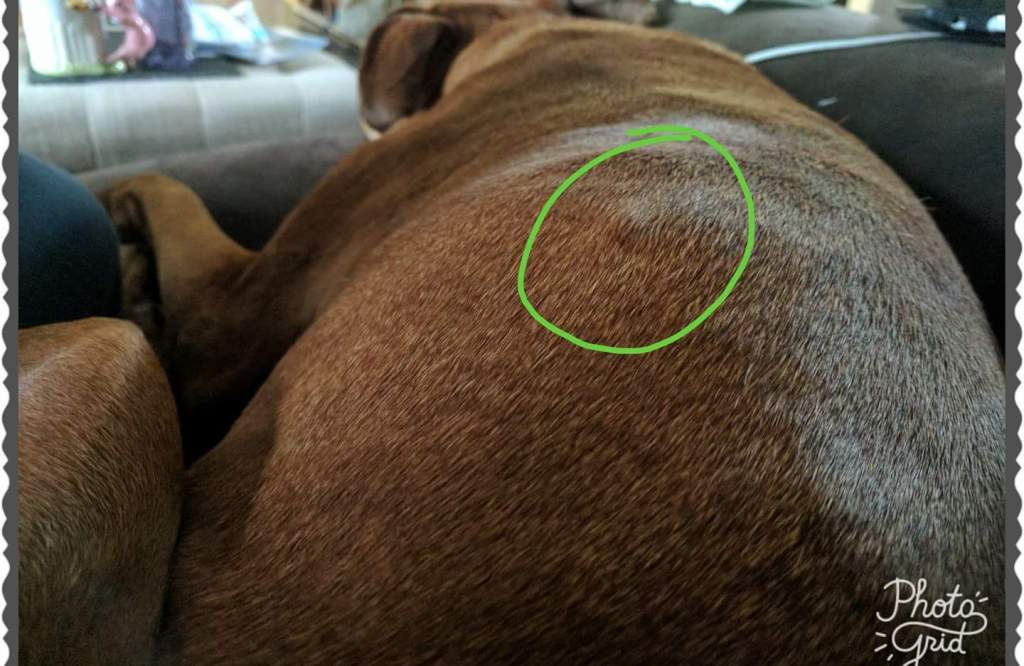
These tumors may develop anywhere on the body surface as well as in internal organs, but the limbs, especially the posterior upper thigh, ventral abdomen, and thorax are the most common sites. Location on mucocutaneous junctions or on the ventral surface of the body is associated with a more aggressive behavior. Many breeds appear to be predisposed, especially boxers, pugs, Rhodesian ridgebacks, and Boston terriers. The tumors vary significantly in size, shape, appearance and texture, but most commonly, they appear as raised, nodular masses that may be soft or solid which usually have dark granules in them. The granules contain substances which, when released, cause swelling, itching, and redness. Infrequently, when a large number of granules discharge their chemical contents into the bloodstream resulting in vomiting, stomach ulcers, shock and even death.
Causes
The cause of most cancers is unknown. With mast cell tumors (MCT), there also appears to be a genetic component, as certain breeds are predisposed to developing MCT. Among the most common victims are beagles, Boston terriers, boxers, bulldogs, bullmastiffs, bull terriers, dachshunds, English setters, fox terriers, golden retrievers, Labrador retrievers, schnauzers, American Staffordshire terriers, and Weimaraners. Boxers are at the highest risk, yet mast cell tumors are often not as aggressive in this breed. There is some suggestion that mast cell tumor development may be associated with golden/red coat color and with chronic immune over-stimulation that occurs in dogs with allergies or other inflammatory conditions. There may be environmental factors, viruses, or other undetermined contributors. Mast cell tumors, as with many other forms of cancer, tend to be associated with age. Middle age to older dogs are more likely to develop MCT’s
Risk Factors
Among the most common victims are beagles, Boston terriers, boxers, bulldogs, bullmastiffs, bull terriers, dachshunds, English setters, fox terriers, golden retrievers, Labrador retrievers, schnauzers, American Staffordshire terriers, and weimaraners. Boxers are at the highest risk, yet mast cell tumors are often not as aggressive in this breed.
Symptoms
The most obvious sign of mast cell cancer is likely to be a tumor of some sort. Mast cell tumors can appear as one, in groups, lie on the surface of the skin or underneath it, crop up anywhere on the body, and defy easy description. It’s difficult to determine if it’s a MCT just by looking at it. Most mast cell tumors are found in or under the skin on the trunk of the body itself, and the vast majority of the remainder are found on the extremities, especially the hind limbs. They are less commonly found on the head and neck, and less commonly still arise from tissues other than the skin. If they are very swollen or ulcerated, there may be pain, but most MCTs are unlikely to be painful. It has been observed that higher-grade tumors may be more likely to be ulcerated in appearance and cause local irritation. One unusually characteristic of mast cell tumors is the tendency for them to change in size, even on a daily basis. A tumor that randomly gets bigger and smaller may be a MCT.
Systemic symptoms are variable, depending on the location of the tumor and the degree to which is has developed and/or spread. Signs of systemic involvement may include: loss of appetite, vomiting, bloody vomit, diarrhea, abdominal pain, dark or black feces, itchiness, lethargy, anorexia, irregular heart rhythm and blood pressure, coughing, labored breathing, various bleeding disorders, delayed wound healing, enlarged lymph nodes.
Diagnosis
The ability to treat a skin cancer successfully depends upon the type of cancer and how advanced it is at the time of diagnosis. Tests will need to be ordered by your veterinarian to determine if your dog has cancer, what form of cancer it is, and at what stage it is.
In order to make a definitive diagnosis, your veterinarian may take a fine-needle aspirate from the growth to submit a sample for preliminary biopsy. The entire tumor will then need to be fully removed, if possible, and submitted for biopsy. Blood tests may include a complete blood count, serum chemistry profile, and buffy coat. The CBC may reflect low or high white blood cell count, low platelet count, elevated mast cell counts. The buffy coat is diagnostic (although subject to false-positives) and reflects mast cells circulating in the bloodstream where they are ordinarily not found in large numbers. A positive buffy coat suggests bone marrow involvement. Other tests may include urinalysis, lymph node aspirate, bone marrow aspirate, x-rays, and ultrasound. The pathologist assigns a histiologic “grade” to the tumor, a somewhat subjective assessment of how well differentiated the cells are and therefore how aggressively malignant the cancer appears to be. The veterinarian assigns a “stage” to the cancer, as well.
Grade: The pathologist will apply specialized stains to the tumor sample and microscopically examine it in order to determine its grade. The majority of MCT are Grade 1 tumors and are well differentiated and appear to have a very good prognosis with no treatment beyond complete surgical removal. Grade 2 tumors are moderately differentiated, and the prognosis and treatment options are perhaps most complicated and difficult to predict. Grade 3 tumors are poorly differentiated, very aggressive, and most likely to rapidly metastasize. They carry the poorest prognosis but are fortunately the least common. Histiologic grade is most predictive of prognosis.
Stage: Staging refers to degree to which the cancer has already spread at the time of diagnosis. Tumors caught early – before they have invaded other tissues or caused signs of systemic disease have the most optimistic prognosis. MCT most commonly metastasizes to lymph nodes, bone marrow, liver and spleen, so much of the lab work focuses on these areas to detect and assess abnormalities. It is unusual for MCT to spread to the lungs, as is so common with many cancers. In simplest terms, Stage 1 refers to a single tumor with clean margins and no signs of spreading. Stage 2 and Stage 3 show progressively greater signs of invasion, perhaps to local lymph nodes, demonstrating dirty margins, or presenting as multiple tumors. Stage 4 involves systemic metastasis and carries a poor prognosis.
Treatment
Treatment options are based on the type and grade of the tumor, surgical feasibility, and the presence or absence of the spread of malignant mast cells throughout the body.
These options may include:
- Surgery may be performed if the tumor has not spread and the entire tumor can be removed without compromising function of the associated tissues. Occasionally it is used to reduce the size of a tumor so that other treatment can be more successful.
- Radiation therapy may be considered for some tumors, particularly when the entire tumor cannot be removed surgically.
- Chemotherapy may be considered for some types of tumors, particularly for those that have spread to other tissues.
- Cryosurgery is a procedure where the tumor and adjacent skin are frozen. It is generally considered for use only with small tumors.
- Photodynamic therapy is a new treatment modality that uses a dye injected into the blood stream that localizes in cancer cells. A laser of a particular wavelength is then used to excite the cells and cause cell death.
Treatment for mast cell tumors usually involves surgically removing the entire tumor, if possible. It is important that a wide margin or large area of healthy tissue around the perimeter of the tumor be removed so as to capture any stray cancerous cells that are not obvious. The tumor is then submitted for biopsy, and a pathology report is generated. It is important to determine whether or not the margins of the submitted tissue removal are clean (showing no signs of cancerous cells) or dirty (showing invasion of cancerous cells). If the margins are dirty, further surgery or radiation may be indicated to attempt to remove or kill any remaining cancerous cells. Nonetheless, a significant proportion of tumors that are incompletely excised (i.e., dirty margins) do not return.
Beside complete surgical excision, treatment options depend on factors related to the aggressiveness and status of the cancer. Low-grade tumors are generally treated locally with surgery, with or without radiation. Radiation may be used after surgery to locally kill off remaining cancerous cells around the surgical site. Sometimes radiation is used in place of surgery to shrink tumors that cannot be easily operated on. Radiation is highly effective in controlling mast cell cancer but this treatment options has certain drawbacks, which include cost and having to sedate or anesthetize the dog for each treatment.
High-grade tumors may be treated systemically with prednisone and/or chemotherapy drugs. Prednisone (a corticosteroid), appears to be the drug of choice in treating mast cell cancer. Many veterinarians will routinely prescribe several weeks or months of
prednisone after the surgical removal of any mast cell tumor.
The benefit of prednisone is that it is relatively inexpensive and safe. Side effects include increased drinking, urination, and appetite, and potential gastrointestinal upset. If a tumor has a reasonably high metastatic potential, or if it has already metastasized, prednisone is likely to be prescribed.
Sometimes chemotherapeutic drugs are used in combination with prednisone if the
mast cell cancer appears to have metastasized. These may include: CCNU (lomustine), vinblastine, vincristine, doxorubicin, mitoxantrone, cyclophosphamide (cytoxan), and L-asparginase. These are all serious drugs with potential side-effects that include severe immunosuppression, vomiting, diarrhea, liver damage. Studies suggest that these drugs have limited usefulness when combined with surgery, and even less so when used alone. Responses to chemotherapy are minimal in cases of MCT.
Sometimes the only option available to a dog with mast cell cancer is supportive (palliative) care because the cancer is too advanced, the dog has other health complications or the owners may not want to pursue aggressive treatment. It is usually the inability to manage such issues as vomiting/diarrhea from gastric ulceration that typically marks the end of quality of life for the dog with mast cell cancer. Thus, controlling symptoms may be more important than battling the cancer. The drugs most commonly used are corticosteroids like prednisone, antihistamines like benadryl, and antacids like tagamet, zantac or pepcid to maintain comfort in dogs. Sucralfate may be helpful with dogs that have bleeding ulcers because it coats the surface of the ulcer to protect it.
Prognosis
Dogs who have had mast cell tumors are more likely to develop more mast cell tumors. It is estimated that 50% of surgically removed mast cell tumors will re-grow in the same area.
Prognosis is variable and depends on many factors including tumor location, histiologic grade and clinical stage. One statistic suggests that approximately half of all MCT’s are curable with complete surgical removal and prednisone treatment. Dogs that are tumor-free after 6 months are considered unlikely to have a recurrence. Primary tumors that originate in areas other than the skin tend to be more aggressive than. MCT in preputial (sheath), perineal (groin), subungual (nail bed), and oral regions areas are generally the most malignant. MCT of bone marrow or visceral tissue is particularly grave. The higher the grade or stage, the worse the prognosis. Dogs showing systemic signs and dogs whose tumors return after surgical removal have poorer prognosis. Similarly, the faster the growth of the tumor, the worse the prognosis. MCT’s that exist locally for several months without showing signs of rapid growth tend to be benign.
Prognosis/Grade-1 MCT: A grade 1, stage 1 cutaneous MCT is likely to never return after surgical removal. The estimated long-term survival rate for dogs with such tumors
is over 90%.
Prognosis/Grade-2 MCT: It is reported that 50-75% of dogs with Grade 2 MCT survive long-term (beyond 35 weeks). Another study concluded that 44% of dogs with Grade
2 MCT survived long-term (over 4 years) after nothing more than complete surgical removal of their tumors. Yet another author reports a 45% mortality rate.
Prognosis with radiation: Radiation may increase survival. One study concluded that 86% of its subjects, dogs with Grade 2 MCT, survived long-term (over 5 years) with a
combination of surgery and radiation (compare that to the 44% mentioned in the previous paragraph). Another author cited a 48-77% remission rate for treatment plans that included radiation. Yet another study reported a 94% disease-free rate at one year
in dogs with Grade 2 MCT (dirty margins) after surgery and radiation, and an 86%
disease-free rate after 5 years. And another study still reflects a 75% survival rate two years after radiation and prednisone treatment. While the statistics vary from study to
study, they all appear to suggest that radiation after complete surgical removal is statistically the most effective way to combat (primarily Grade 2) MCT.
Prognosis with prednisone: Prednisone, with or without other chemotherapy, is estimated to induce partial or complete remission in approximately 20% of dogs with MCT.
Prognosis/Grade-3 MCT or metastasis: Only 15% of dogs with Grade 3 MCT will be alive 7 months after surgery, and only 6% will be alive after 2 years. Once mast cell
cancer has metastasized, dogs tend to die within several months as the symptoms of systemic illness (e.g., gastric ulcers) can no longer be managed and the animal loses its
quality of life.
 KetoPoweredK9.com