
Here I will compile a List of things I’ve learned while feeding keto to try and help others!
When to Take Glucose and Ketone readings?
- Do I have to measure the blood to feed a ketogenic diet? No, you don’t “Have to” but it is the only way to verify if the dog ever gets into ketosis. and without verify you are only guessing. Just because you are feeding your dog a ketogenic diet doesn’t guarantee your dog will be in ketosis. Glucose and ketone blood readings are the ONLY way to verify. And ketone urine strips are not a reliable way to do this. My dog Emie is the perfect example of why it’s so important to test the blood. When we first started keto we had to do numerous calorie reductions to the diet before we were finally able to get her in ketosis verified by glucose and ketone readings, a Mere 100 calories could make or break getting a dog in ketosis. Had we not done the blood testing we would have never known what was going on and what changes needed to be made to the diet. Take home message here– Just because you are feeding a ketogenic diet doesn’t guarantee your dog will be able to get into ketosis. We need to verify with proper glucose and ketone readings. That’s right! we need to be measuring both glucose and ketone levels, not just one or the other
- It will generally take about a week depending on the dog to get into ketosis, if the dog is coming from a kibble fed diet it may take longer. if you already have your meter at the very beginning of the diet, you could take glucose readings just to see where the sugar level is, but it certainly is not a requirement before you start keto.
- WHEN TO TAKE THE READINGS? I like to take 1 reading in the beginning of the week in the morning right after my dog wakes up, minimal movement etc. and before eating.
- HOW OFTEN ? Then I try and take the 2nd reading for the week towards the end of the week on Friday 2 hours after her 2nd meal. If you only feed 1x a day then just take the reading 2hours after that meal. You can’t test “too much” , test strips are expensive, but the more you test, and at different times, and that data you record and gather will give you a better insight as to your dogs average readings. And remember, these levels are CONSTANTLY changing! we can take 10 different readings and we will get 10 different results. we are only capturing a “snapshot” of those levels at that exact moment in time when we draw that little blood sample.
- If your dog is having a seemingly tough time getting the glucose levels lower, make sure you are trying to incorporate exercise in your dogs daily routine. and take a glucose reading 1/2 to 1 hour after exercise to see what effect exercise has on lowering glucose levels. Exercise can usually have a profound effect on lowering glucose levels!
As you can see in my photo below , I took 3 glucose readings on my dog Emie , before exercise, 15 min after exercise, and 40min after exercise. Mind you, the night before was “treat night” so that probably explains the really high 111 glucose reading. I’ve NEVER in 4+ years seen her glucose level that high! so this is a perfect example of how much we can possibly lower glucose levels by with exercise. 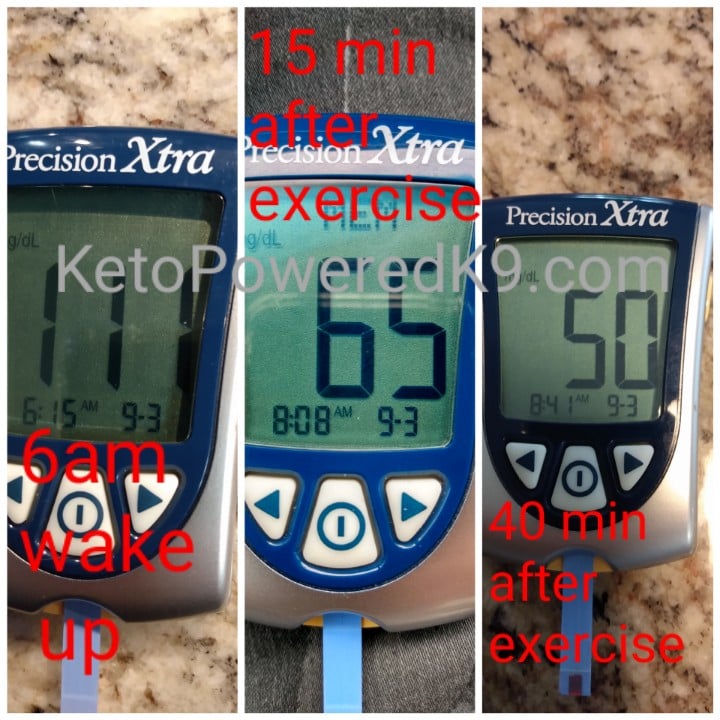
- It’s crucial to keep your dog as calm as possible, reduce their stress as stress can easily spike glucose levels and give a false reading. Sometimes people will try to take their dog to the vet to have them perform the blood glucose/ketone readings, but the overall environment of taking any dog to a vet easily stresses them out and it’s almost pointless to try and get an accurate reading this way. practice and do it yourself at home for best results.
- And keep in mind that it is much easier for dogs to lower their blood glucose than it is for them to have measurable amounts of ketone levels. But just because dog’s have lower measurable amounts of ketones in the blood doesn’t mean they aren’t producing them! we can hypothesize that perhaps dogs are more efficient at utilizing the ketones vs. humans and perhaps that may explain why we may see lower plasma levels of ketones in the blood. But by the mere fact that while in ketosis the dog isn’t experiencing hypoglycemia proves that the ketones are in fact being produced.
so generally speaking we can expect to see lower measurable levels of glucose but plasma ketone readings will not be comparable to that of human ketone readings on a ketogenic diet. So my dog for example, doesn’t see very high ketone readings- .2-.3 is pretty standard for my dog and I’ve seen a random .4-.6 a few times. On the high fat 2:1 ketogenic ratio meals her glucose was generally pretty low in the 30’s-40+ range. - CAN’T I JUST USE KETONE TEST STRIPS?
No, trying to use ketone urine strips are not a viable option as they are simply measuring excess ketones that the body is not utilizing and excreting through the urine. This is not a true representation of ketone levels that will be in the blood. Plus not to mention, we might expect to see a higher amount of excreted ketones in the beginning of ketosis because their body has not become fully fat adapted to use those ketones, so the excess ketones will be excreted in urine. But once the body starts becoming fat adapted and utilizing those ketones more efficiently we would expect to see those ketone readings plummet on a urine strip. So we could then be getting a false reading of low or no ketones on a urine strip. And another thing to keep in mind is that dogs will have a much lower measurable blood level of ketones compared to humans. Where a human in ketosis may very well see ketone levels of 1-2 mmol, a canine in ketosis will more than likely be in the range of .3-.9 mmol. So with blood ketone levels on the low side to begin with, there may not even be any excess ketones in the urine to measure if one were only rely on ketone test strips.
More on Ketone Body Metabolism can be found on my page here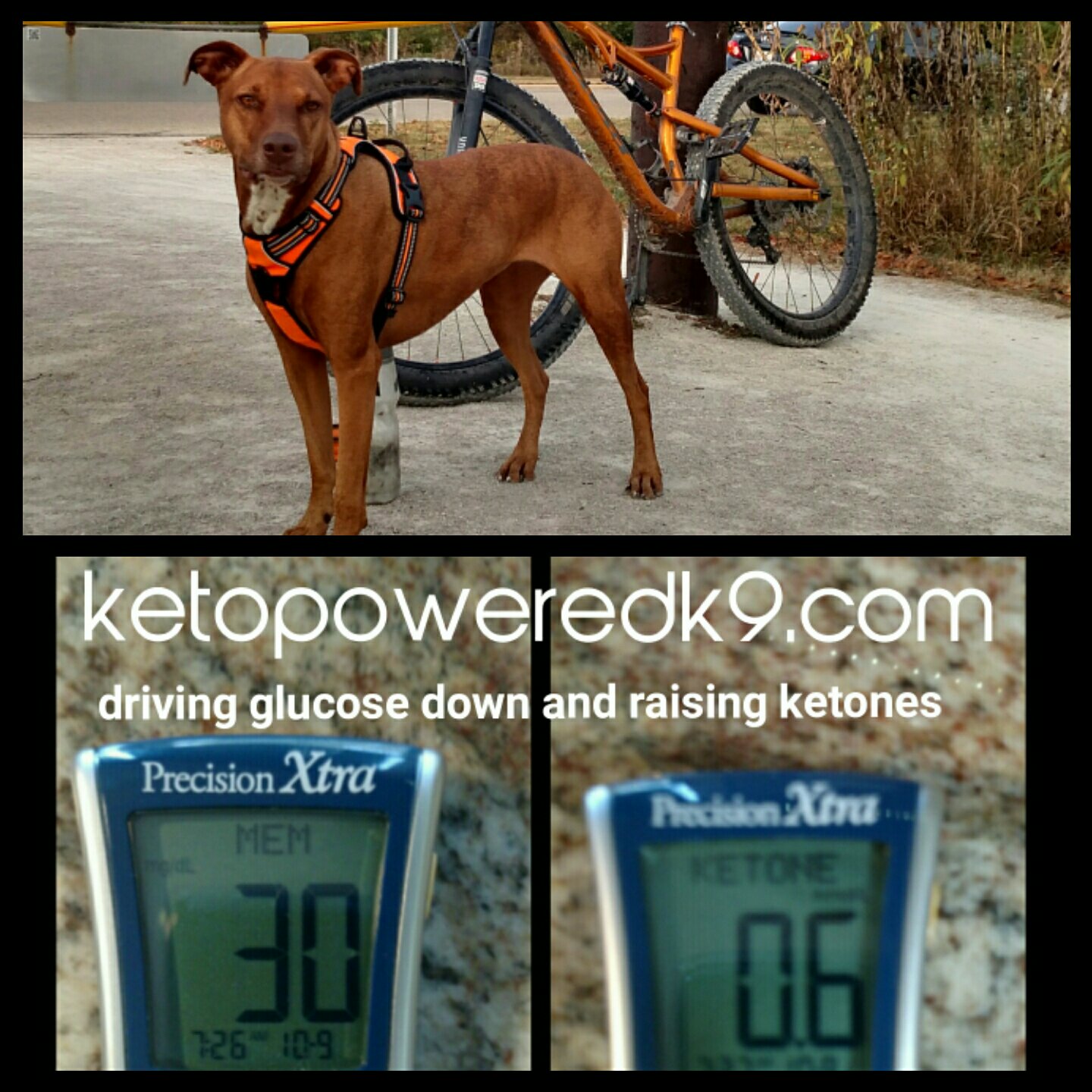
What Meter should I use?
The precision Xtra meter (shown in the picture above) is the meter that seems to work the best with dogs. Although it is intended for use in humans, it does the job for our dogs too. This is the same meter recommended by ketopet.You may be tempted to try other brands such as the KetoMojo that requires less expensive test strips compared to the precision brand, but I will warn you that this brand did not work for my dog to test ketones and it has been reported by several other members of the Ketogenic Dog Group to not work on their dogs either. So I only recommend the Precision brand meter.
In addition to the meter, you will also need the test strips. There are specific strips to test glucose (sugar) and a different strip that measures Ketones. So you will need both. It’s important that we are measuring both glucose AND ketone levels and not just one or the other.

Below are Amazon links for the products I use. ( if you are located outside the US, search Ebay and/or search for the Freestyle optium Neo if you can’t find the Precision Xtra model)

If you purchase the strips in Bulk, It is more affordable per strip


larger 28 gauge lancets


Tricks and tips for taking blood readings
First and foremost- Before you even attempt to get a sample with the actual lancet, first PRACTICE with your dog just to get them used to the motions! you are setting yourself and your dog up for failure if you just try to jump right in this and expect to get a blood sample on the very first try.
- use a 28 gauge lancet if you have a hard time getting a decent blood sample with the thinner lancets that most meters come with.
- There is no need to use the “gun” to fire the lancet, it will just scare them with the noise. simply take the lancet and hold it in your hand to press it in to get a blood sample.
- I take the blood sample from the inside of my dogs lip- alternate spots are inside the ear, paw pad, callous on leg area, or their carpal pad.
you can find many examples online if you simply google “taking diabetic glucose blood sample from dogs ear flap” be warned, most information online will be advertising expensive “DOG SPECIFIC” testing meters, but rest assured we always use the much less expensive “human” versions of meters and testing strips to do this! - If your dog doesn’t give enough of a blood you probably need the 28 gauge lancets.
- If your dog refuses to let you take the blood sample, you have to hold your ground and give them some tough love. Emie hates it, but she also hated me cutting her nails and after enough persistence I can now cut her nails with no struggle, So you have to show them who’s boss sometimes to get them to do things they may not otherwise do willingly! please note: if your dog is getting overly stressed while taking the blood reading, this will elevate the glucose reading. so overtime, its important that the dog remain calm during the blood test to try and get an accurate glucose reading. So if your dog is struggling with you at first, you more than likely will get elevated readings. practice makes perfect, work on this overtime so they get adjusted to the procedure.
- Don’t expect to just be able to do this on the first try. With my dog Emie, I first started by simply taking the lancet, leaving the protective cap on the needle, holding it between my index and thumb, then I simply got her used to the routine of me touching it to the inside of her lip and then giving her hi praise “GOOD DOG!” and repeated that over and over until I finally started doing it with the protective cap off and actually pricking her with the needle.
- protip! : while you are waiting for your meter to arrive, you can start practicing the routine to try and get your dog used to it. use a toothpick to simulate the feeling of the lancet. Get them used to the procedure. Because if they are all stressed out when you actually go to do it, you will get false readings. The more and more you can get them accustomed to this procedure, the more likely they will remain calm and give you an accurate glucose reading. If they get nervous/panicked, the glucose levels will spike and give you elevated readings!!!! yet another reason why it’s pointless to attempt to bring a dog to the vet to have this done, the entire process of just going to the vet will get them all “amped up” and elevate glucose readings.
I’ve heard people talk about “keto flu” for humans, will my dog experience this?
This is a big problem for improperly balanced home prepared raw ketogenic diets and yet another example of why it is important to know what you are doing if you take it upon yourself to attempt a home prepared Raw ketogenic diet. To get an idea of just how much goes into properly formulating these diets, visit this page HERE
How Do I know if my dogs home prepared ketogenic meals are providing all the vitamins and minerals my dog needs?
If you’re doing the “Basic” version of the meal, your dog is NOT getting all the nutrients it needs. More details HERE
Where can I get custom formulated Ketogenic Diets?
Click HERE for more info on private consultations
Tip for giving any additional meds/pills throughout the day
We don’t want to be feeding things like pill pockets or peanut butter to hide them in, so a Keto Friendly tip is to use a small amount of cream cheese to hide pills in to feed your dog. Or just some plain ol’ ground beef you’re probably already using in the keto meal, or butter, coconut oil etc..
General food, supplement, vitamin tips
- be VERY careful when choosing what to feed your dog while on a ketogenic diet, we do not want to introduce any sugar or carbs to the diet. and sugar can be hiding in the least suspecting things such as liquid vitamin supplements for example! you must inspect everything you are considering feeding! Items like Dr.Harvey’s Paradigm is sometimes mistakenly used as a “multivitamin” or way to bring in missing nutrients to these diets, but this product drastically lowers your ketogenic ratio! therefore is not advised to use with these diet. For example , just 1 scoop of that product can take a 2:1 ketogenic ratio and lower it to a 1.6:1 ketogenic ratio
- limit most polyunsaturated fats as they don’t always convert well
into ketones” example of polyunsaturated fats - CBD oils have been reported by some members to drastically increase their dogs glucose levels up over 30points. so ALWAYS check glucose on a regular basis to spot any abnormalities that need to be addressed!
- “dog branded” chewable supplements and/or probiotics are NEVER keto friendly, so avoid these at all costs if you are trying to adhere to a strict keto diet for your dog
Click on the banner below to watch the interview with
Dr.Karen Becker


 KetoPoweredK9.com