updated April 2023
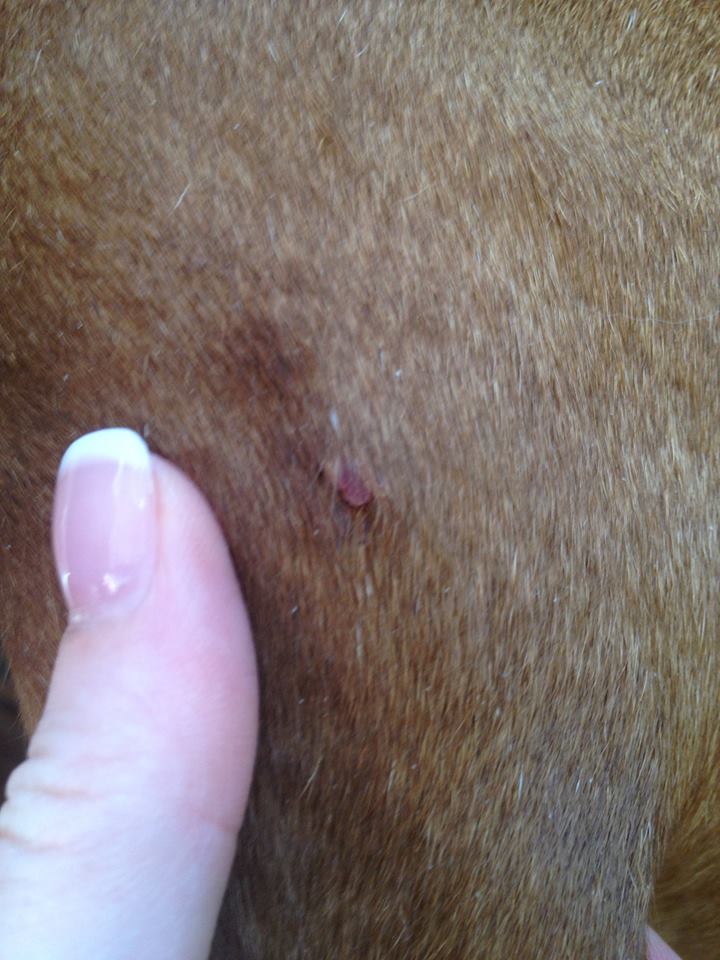
It’s imperative to ALWAYS get any new lumps and bumps checked out by your vet! no matter how small or unassuming they may look they can be a major problem, do not wait or put it off, catching these early can make all the difference in the world. MCT’s have been known to be called “The great impostor” because of its many different shapes, sizes, above skin, below skin and sometimes how innocent looking they can be as shown in my pictures below.
You can never tell if a spot is Cancer just by looking at it
It’s important to point out that when I first brought Emie in for her appointment back in June of 2017 to have the little bump looked at, our vet at the time kind of shrugged it off and wasn’t overly concerned about it. leaning towards the notion of just leaving it be and “seeing what happens”
It wasn’t until about halfway through our appointment that day that I questioned it again and pushed the idea to just do the fine needle aspiration (FNA) so we could conclusively know WHAT we were dealing with. Later on that same day I got the news that the FNA results were in fact Cancer. MCT (Mast cell tumor) and in her case it was subcutaneous (under the skin)
Had I not pushed the issue that day, and we walked out of that office without doing that FNA who’s to say what may or may not have become of that little bump….. It could have stayed just the same and never changed, or it could have grown in size or metastasized to other parts of her body and her life could have had a majorly different outcome.
Moral of the story. I’d rather know for sure than leave it to chance. MCT’s can be very unstable and balloon up in size in a matter of hours. And even worse, they can metastasize to other parts of the body like wildfire just like any cancer can.
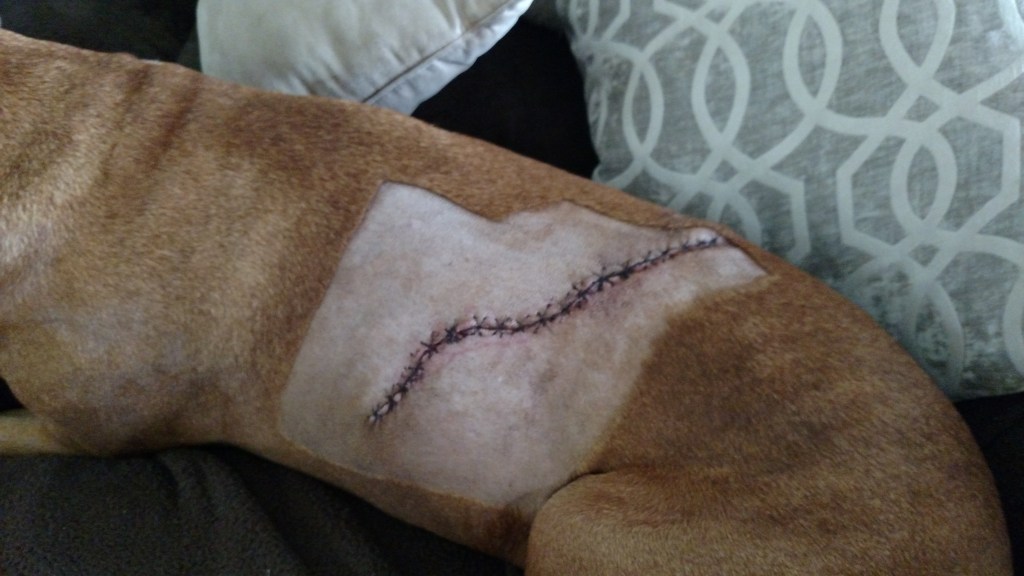
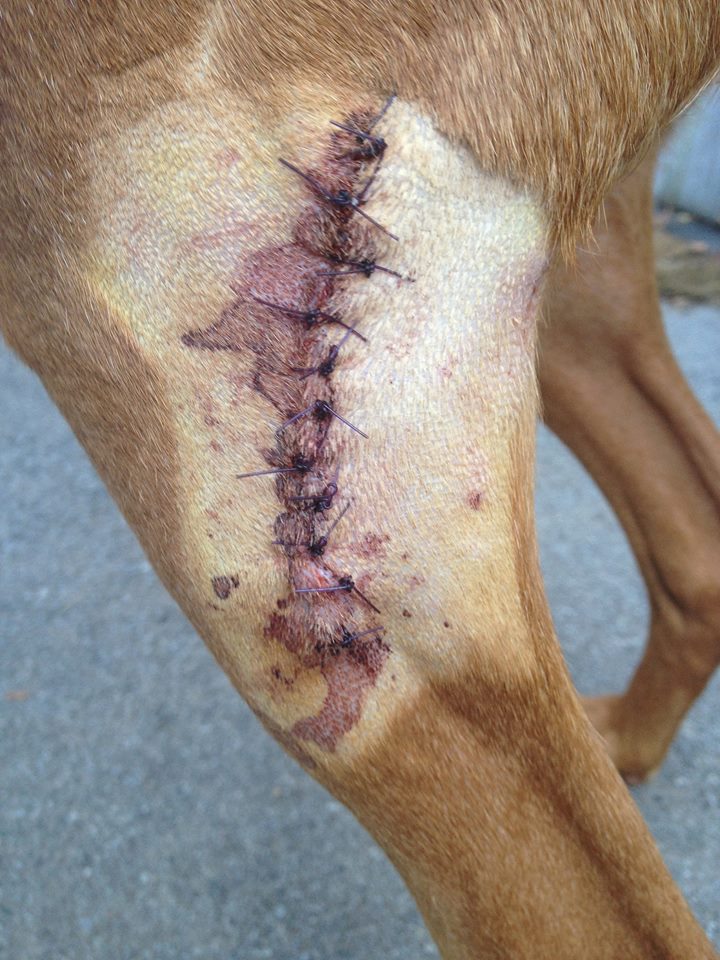
The top 2 pictures below highlight the MCT my dog Emie had, and you can tell by my picture that it was very tiny but resulted in a pretty major incision leaving her with a scar halfway around her torso. luckily, we caught it early and brought her in to our vet before it had a chance to become an even bigger issue. And below the picture of my dog is our friend’s dog Renny (RIP) who also had a very small MCT on his leg. These pictures are examples of just how small these can be- the images of the incisions may be graphic to some but there’s no way to sugar coat illustrating how large the incisions actually are to remove these unassuming small tumors. In order to try and ensure that all of the cancerous mass is removed, a much larger area than just the bump has to be removed. This is called the margin. The margin of area around and below/beneath the tumor must be removed to ensure the best chance that all of the cancerous mass has been removed. And this can prove to be very difficult when MCT’s are located on limbs/legs or head areas. If you are dealing with a MCT in a difficult to remove area, always consult a board-certified surgeon if your vet has any reservation of getting a “clean margin” removing an MCT. You only get one shot at this.
Traditional veterinary practitioners told us that we really didn’t have to do anything or change anything in Emie’s lifestyle and to just keep an eye out for any new lumps and bumps. The vet we had back then basically just told us to call him if anymore bumps popped up. And to me that sounded ludicrous that NOTHING needed to be changed in her life. Instead, I went home and changed everything in my dog’s life after that experience.
The very first thing I changed was her diet from high starch/carb kibble to raw home prepared Raw Ketogenic Diet. It’s important to note that ANY home prepared diet is crucial that it be balanced to meet ALL nutrient requirements for your dog. More info on that here
It’s also important to point out that a RAW ketogenic diet is not at all the same as a “standard” raw diet. With keto, we’re getting the body into ketosis and we’re restricting protein whereas with a standard raw diet we’re feeding copious amounts of protein. Remember, not only does cancer thrive off of glucose from carbohydrates, but cancer can also utilize protein. Very Detailed information of how Ketogenic diets are useful for cancer can be read here
Along with other lifestyle changes- filtered water, fluoride free, no lawn pesticides, no chemical flea/tick treatments, safe shampoos, titer testing before any future vaccines, organic grass fed AND finished meats sourced from a private farm shipped to me direct, organic vegetables, re-assessed our home environment- no more scented candles, plug-in diffusers, things of that nature, no more processed pre made dog treats either- I dehydrate single protein meats as treats and give raw meaty bones, chicken wings, things like that are now her “treats” . (for more info on titer testing click here)
MCT is notorious for sometimes coming back with a vengeance once they are removed with surgery- some estimates say 50% of removed MCT tumors will re-grow in the same area.
Remember! removing the tumor is only removing the symptom- we need to try and address the cause!– This is why I was so steadfast in keeping her on the strictest, healthiest diet and lifestyle I could possibly afford her. Some dogs can have a MCT removed and go on with their life without a care in the world with zero diet/lifestyle/vaccine changes and go on to live a ripe old age. And then there are the other dogs who have to deal with Pandora’s box of never ending MCT’s that are constantly coming back and eventually taking over with no end in sight.
As of August 2022, I have had my dog on a Ketogenic diet for over 5 years, with no further recurrence of MCT. Further disproving any hearsay that these diets can’t be sustained long term. But it is extremely crucial that they are done right and properly nutritionally balanced. I’ve seen far too many people mistakenly think they can feed the dumbed down version of these diets long term which only consist of 3-4 basic ingredients. This is exactly what we DON’T want to be feeding a dog for any substantial amount of time.
UPDATE April 26th 2023- It is with a very heavy heart that I have to write this- Emie did unfortunately succumb to cancer in February of 2023- With just 6 years shy of being cancer free since her MCT diagnosis, and being at the pinnacle of health for many years, she went from being perfectly healthy one day, started showing signs of mobility issues, stopped eating, brought her to the vet asap and was diagnosed with Cancer riddled throughout her inside abdomen , this all happened so incredibly fast there was simply nothing that could be done at that point. This scenario is much the same as what happened to Renny below. So MCT is not a cancer that should be taken lightly. It is extremely unpredictable. But there is no doubt in my mind that everything I did to support her through the Ketogenic diet only helped her for all those years. If we had stayed on the same path as we started, there’s no way she would have had all of those years of such health. PubMed published a case study of a dog with MCT only using a Raw Ketogenic diet as well, in that case report they mention the median survival time for Grade II Mct is 21.5 months (grade II is what my dog Emie had) , so we were fortunate to crush that 21.5 months survival average by OVER 4 additional years. Link to that pubmed case study HERE
Don’t follow blindly.
When I first started researching MCT with dogs, a lot of people told me that I HAD TO put my dog on the “Benadryl and Tagamet/famotidine/antacid” protocol and that my dog would HAVE TO stay on that protocol for life. I admit, I blindly followed and started that protocol with my dog, but then after I researched more, I learned that this isn’t always necessary for dogs with MCT history, so I chose to stop that protocol.
So had I kept my dog on that protocol she would have been subjected to hundreds upon hundreds of unnecessary doses of those over-the-counter drugs for no good reason. and those OTC drugs don’t come without their own side effects! I’m not saying that this protocol doesn’t have its good use, because it does. BUT each dog’s situation is different and sometime when “blanket statements” are made advising that ALL dogs with a certain condition must follow a certain protocol, this isn’t always true. So, it’s important to always do your own research.
Another thing that I was told is that “dogs with MCT MUST avoid high histamine foods!” I listened to that too, but later learned that not all dogs are affected by histamine rich foods. If you know your dog is histamine reactive to these types of foods, then yes avoid them. But if your dog is NOT reactive to foods higher in histamine, then just because your dog has a history with MCT cancer, it doesn’t mean we automatically have to avoid these foods. For the first 6 months after my dogs MCT cancer diagnosis, I avoided all foods higher in histamine because this is what people told me and this is what I read online. BUT after more research and learning I decided to give it a shot and take a chance, and 5+ years later we have had no issues feeding foods higher in histamine. Again, this is my personal experience, and the moral of the story is to do your own research. Social media can be a great tool, but there is also a lot of misinformation floating around and not every situation has a “one shoe fits all” solution.
I urge people to share this webpage article to raise awareness of MCT .
Over-vaccinating is a big concern, especially a dog that has cancer. Dr Becker touches on this topic in the video below. But to make a long story short, vaccines are only intended to be given to healthy dogs. A dog with cancer is not healthy. More info on the vaccine debacle can be researched through protect the pets and the rabies challenge fund. Google them.
The physical sign of cancer, a tumor, is the SYMPTOM that something is “out of whack” in the body. Even if we cut that tumor out through surgery, if we don’t address the underlying issue of trying to get the body back in homeostasis, there are very strong odds the cancer will simply return. And sometimes more often than not, it can come back stronger than before. You see this happen with many dogs that undergo surgery to remove MCTS. We have to address why this happened in the first place to improve our longer-term odds of it not coming back. If you elect to have surgery to remove the tumor, it is imperative that you discuss with your vet how confident they are that they will be able to get CLEAN MARGINS. if your vet has any reservations whatsoever as to their ability to get clean margins, I will highly suggest you get a consultation with a board-certified surgeon for this matter as we only get one shot for this surgery do be done right and there’s nothing worse than having a mct removed just to then get the results that they didn’t get clean margins. In layman terms, Margins are essentially ensuring that all of the cancerous tumor was removed, and no traces were left behind.
I’ve never let my guard down with my dog Emie and I’ve never strayed a single day on her ketogenic diet, and we were very fortunate for 5.5 years of no further recurrence of her MCT.
At the bottom of the page is the link to the NCCF article with more information on MCT’s- Description,Classifications, Grading, Staging, Causes, symptoms, treatments, prognosis. I would urge you to watch the presentation by the senior pathologist explaining that the grading and staging system is not perfect and is in fact heavily flawed. MCTs that are graded low can turn out to be high, MCTs that are graded high can turn out to be low etc.
This pea sized lump was on my dog Emie

The resulting scar from her surgery
Another Example of a very small MCT that later developed in other parts of the body
Very small mass on our Friends Vizsla Renny- This could easy be overlooked as no big deal- Again, the very small spot below was diagnosed as MCT. later it developed on her ear resulting in part of the ear being removed, and ultimately Renny suddenly passed away only to find out her entire body was riddled with cancer unbeknownst to anyone at the time
Resulting incision
Tribute to Renny 02/02/07-05/21/17

Perhaps one of the most informative videos on lumps and bumps by Dr.Becker
Informative article on MCT from the National Canine Cancer Foundation- click here
Links to other related MCT information click here
Dr.Karen Becker- November 04, 2017 article click here
Stelfonta- nonsurgical removal of mcts/removal of mcts in places standard surgical removal may be very tricky info here
packet information for Stelfonta with list of adverse reactions. click here
Get started feeding your dog a Raw Ketogenic Diet !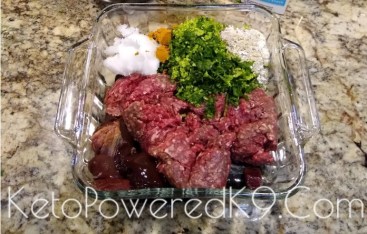
click on the picture to learn more!

 KetoPoweredK9.com